
35 New scholarships and other reinvestments from the surplus funds
The coronavirus pandemic has a lot of dark sides. Around the world, schools closed, the healthcare system got overloaded, employees lost their jobs, companies faced bankruptcy, stock markets collapsed, and countries had to spend billions on bailouts and medical aid. And for everyone, whether directly hurt or not, Covid-19 has been a huge stressor shaking up our psyche and triggering our fears and uncertainties.
No matter how serious and sad all of this is, there have been upsides as well. As the good old SWOT analysis tells us, there are not only threats but also opportunities. The main opportunity the pandemic offered to Aiducation was the availability of surplus funds from the scholarship funds because of reduced school fees, especially in Kenya. This was possible as the Kenyan government subsidized the school fee costs to parents and Aiducation. This has enabled us also to reinvest the funds in other impact-generating sectors including awarding 35 new scholarships, investing in more mentorship programs for our scholars, and investing in a laptop library for our talents in Kenya and the Philippines. Other areas we have also invested in include safety cushioning of the organization and transformation into a circular-for-impact organization. All these have been possible because of your continued support.
Below are more insights on the surplus funds and how we have been able to reinvest the funds...
The year 2020 began with high expectations. Yet, in March 2020 Covid-19 hit the world and disrupted normalcy across almost all aspects of life. The pandemic had an impact on countries, communities and our individual lives and behaviors. One of the sectors hit worse by the global outbreak was education. Millions of learners weren’t able to attend school, as governments closed schools and universities. Most educational institutions reverted to long-distance learning formats. Such a sudden shift posed huge challenges, especially for students from poor backgrounds. Their main challenge was a lack of access to the necessary technology. This was true for our students across Kenya and the Philippines.
Impact of Covid-19 on the Education system in Kenya and in the Philippines
In Kenya, the government closed schools for about a year in a bid to reduce the spread of the virus. Physical learning was disrupted between March 2020 and January 2021. During that time learning stalled or stopped as most schools had not fully adopted the needed technology. Once schools reopened, the educational systems in Kenya had to pick up from where learners left off in 2020. The schools had to cover four instead of the normal three terms per year. This resulted in a crash program with shorter terms and holidays. The intention being to enable students and teachers to make up for the lost terms and resume normalcy as soon as possible.
The Philippines were one of the worst-hit countries by the pandemic, globally. The country was in lockdown until April 2022. Learning transitioned to online formats up until September 2022. Only since then have schools started to resume in-person learning. Although most learning still happens in a blended format.
Impact on Aiducation Programmes
The shorter school terms had an impact on the structure of school fees. Also, government support in the form of extra subsidies lowered the costs for parents and Aiducation.
This reduction in school fees enabled Aiducation to not only invest in 35 additional scholarships but we were also able to leverage our scholarship impact along other relevant areas:
- Laptop Library: Access to technology has become a precondition for learning. Beside remote learning access during the pandemic, this also applies to Aiducation's increasingly virtual programs like academies and e-mentoring. For this reason, we have established a laptop library in Kenya and the Philippines with 40 laptops each. Our aim is to further grow the library moving forward.
- Coming out of the pandemic, we see an increasing need and positive impact of bringing our high school students together. We are organizing more physical on-site mentorship academies for our high school scholarship beneficiaries supported by mentors and coaches from our alumni network. We are hosting these programmes decentralized, across the country with a stronger focus and less attendees. Besides this, we provide our students with more mentoring and counselling programs.
- Along our employability and entrepreneurship streams, we have intensified and sharpened our trainings to increase the transition rate into further education programs and/or careers by collaborating with local partners.
Safety cushion and all around
Based on the economic situation, we are expecting a massive price increase on school fees post-covid. For example, transport costs have tripled in Manila and in Kenya, a kilogram of corn almost doubled in price. Therefore, we are investing into a safety cushion in order to absorb rising school fees.
In addition, Aiducation is continuously working on its transformation into a circular for-impact organization. This includes an update to our website for our AiduMakers and a sustainable growth plan for our for-impact organization.
Thank you for your impact
We are grateful for all your contributions which are impacting the lives of 35 underprivileged, highly motivated youth and beyond. Making all their dreams come true.
We thank you for your continued trust and commitment. Your support allows us to sharpen our circular for-impact model. You enable us to work towards the United Nations Sustainable Development Goals, and we will further intensify our collaboration with local partners along Sustainable Development Goal 17.
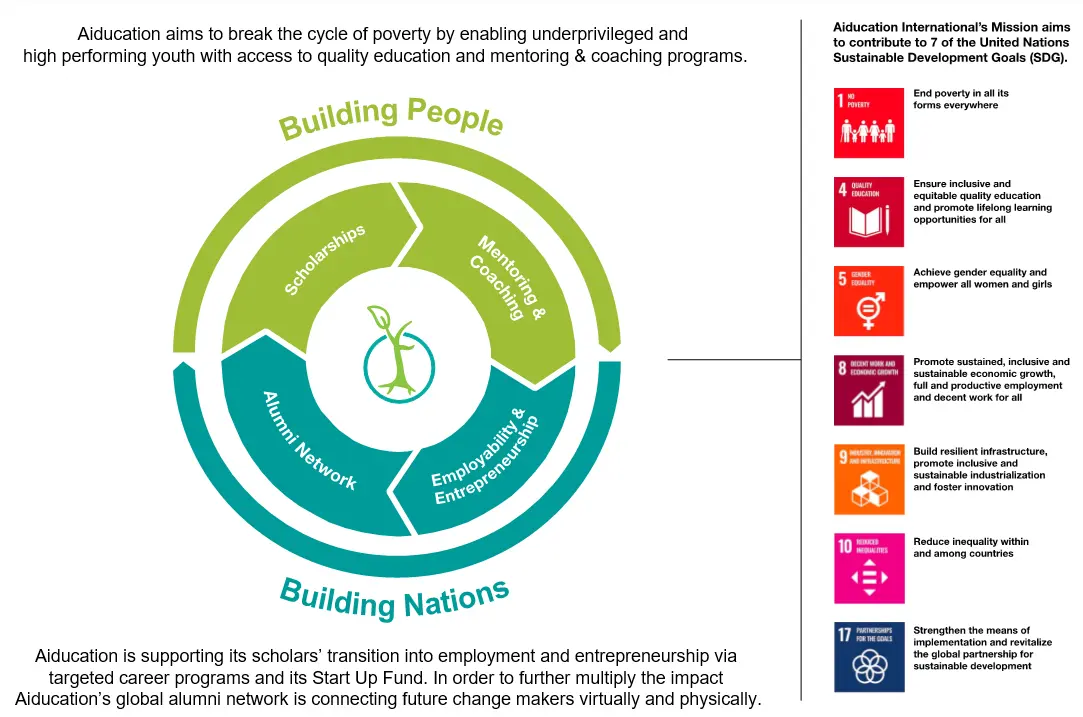
Our circular for-impact model and SDGs
BUILDING PEOPLE. BUILDING NATIONS.